
Helping golfers play better, healthier golf
GOLF FITNESS MONTHLY
Foot Inversion and Loss of Distance in the Golf Swing – https://read.nxtbook.com/ggrw/gfaa/march_2025/where_to_start.html
FLEXIBILITY, A PREREQUISITE FOR POWERING UP YOUR GOLF SWING
BETTER BODY, BETTER SWING, BETTER GAME
Come on, admit it. You’d like to be a little longer off the tee. Who wouldn’t? “Distance” and “Power” are the common catch words you see in almost all golf club advertisements. But I’ve got news for you. It’s not the clubs. It’s your lack of flexibility that is impacting your ability to power up your swing.
I know because I’ve seen it in almost every golfer I’ve worked with, especially the older ones. The inability to move around a body joint, or what is commonly known as range of motion, is taking away your capacity to generate power and clubhead speed, hurting your distance on the golf course. For many, that’s also taking away the fun of playing.
The good news is that it’s an easy fix, but you have to put a little work into it. Not a ton of work, about 10 to 15-minutes most days of the week. Every day would be ideal and would also probably leave you feeling better. It could also help to alleviate some of those nagging aches and pains you’ve been dealing with.
Our muscles, tendons and ligaments need to move and stretch. When they don’t, they tighten up. The less active you are, the more they tighten. Think about how much sitting you do during the course of a typical day. It probably adds up to quite a bit if you’re a typical adult person.
Even if you are active, your muscles will tighten up if you don’t take the time to stretch them. Activity strengthens muscles and stronger muscles become tighter muscles if not stretched. Envision the stereotypical body builder who can’t raise his arm to comb his hair. Not so much because of his big, bulky muscles. He’s tight!
That’s why a stretching program is vital and is the reason why flexibility is probably the most important component when it comes to golf. . . and feeling good every day. Give it a try for a couple of weeks and feel it for yourself. I bet you’ll see a few extra yards down the fairway, as well.
Here are a few good static stretches to help you get started. Hold each stretch for a minimum of 30-seconds, unless otherwise instructed, and remember to breathe normally throughout.
Hip mobility is crucial in the golf swing. These first three stretches will focus on some of the muscles that will impact that mobility. In addition, tightness can contribute to lower back concerns regardless if you swing a golf club or not. Keep in mind that the point of pain is often not the cause of pain and tightness in the hamstrings or hip flexors can certainly play a role in lower back discomfort.
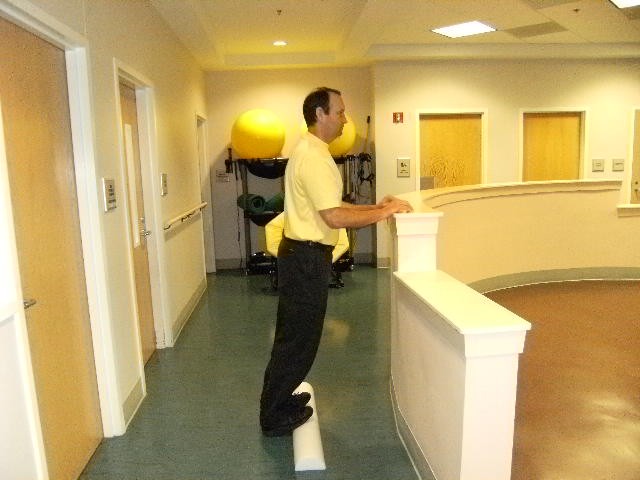
Calf Stretch – place your toes up on a ½ round foam roll (a 2×4 can be used as well). Place your hands against a wall or counter and slowly lean into the wall until a gentle stretch is felt. Hinge from the ankles and keep your entire body nice and stiff, don’t bend at the hips. The heels need to remain in contact with the floor.
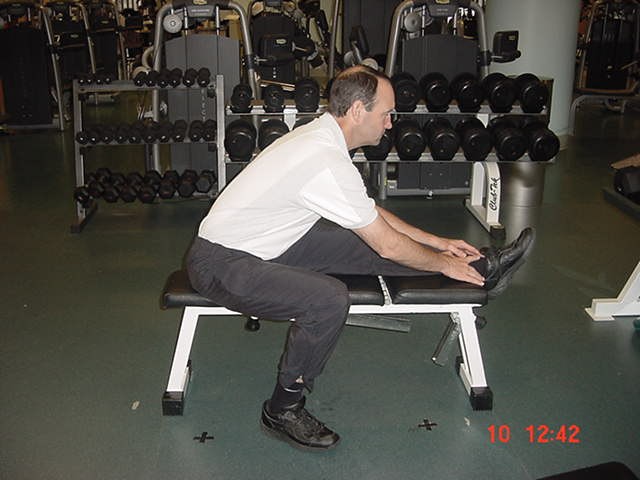
Hamstring Stretch – sitting on a bench or solid flat surface such as a coffee table. Placeone leg up on the bench with the foot relaxed and extended over the edge. Slowly reach down the raised leg with both hands until a gentle stretch is felt in the back of the leg. Don’t bend the knee and make sure you hinge from the hips, keeping your chin up and back straight. Don’t bow the back in an attempt to reach further down the leg and make sure the foot stays in a relaxed position. Flexing the foot or pulling the toe toward you will engage the calf, which may take away from the isolation of the hamstring. Switch legs and repeat.
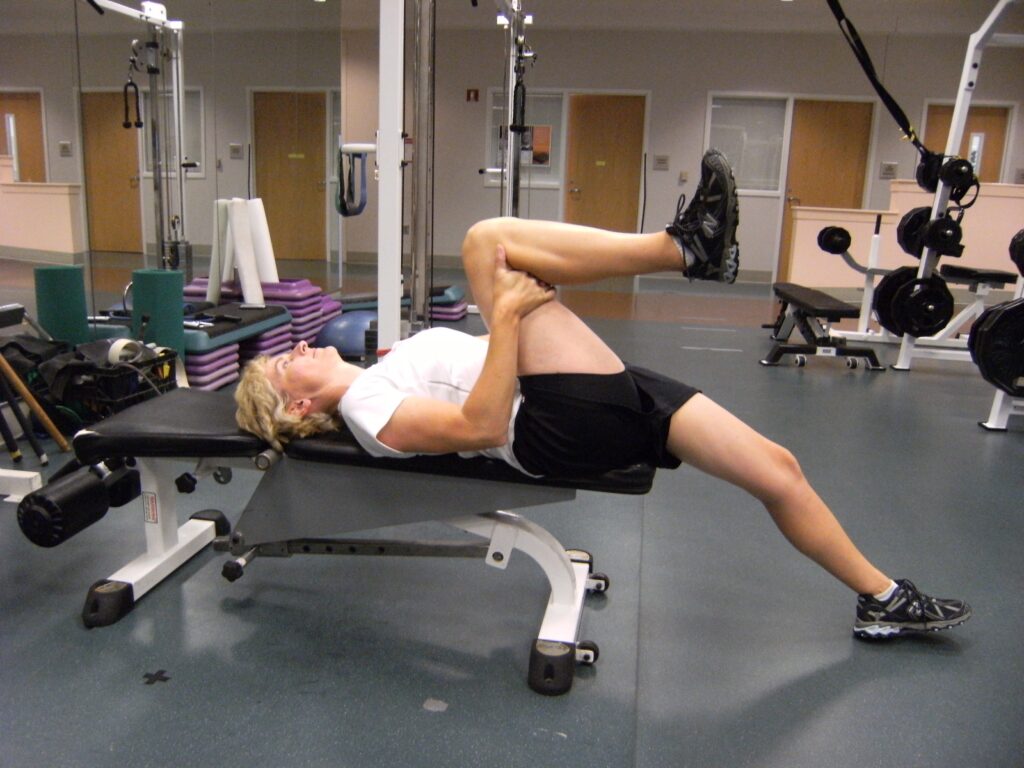
Hip Flexor Stretch (Knee Hugs) – lie on your back on the floor. Keep the right leg down and bring the left knee up towards the chest. Grab onto the left knee and gently pull it into the chest. Repeat with the other leg. This can also be done on a flat bench (as shown) or solid coffee table. This will offer a better stretch as the extended leg is now below ground level.
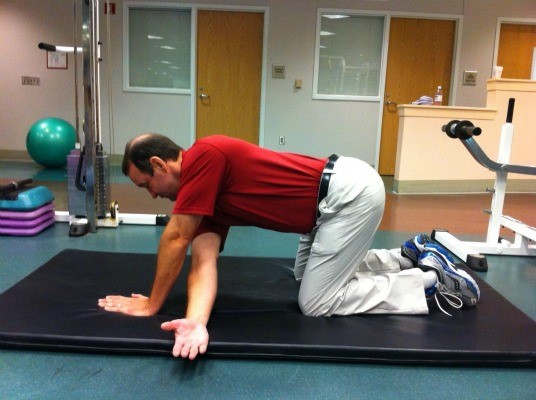
Reach Thrus – kneel on all fours and keep your weight slightly back toward your heels. Take your right arm and slide it along the ground over to the left until a gentle stretch is felt in the back. You can lower the right shoulder toward the floor to obtain more of a stretch. Hold for 10 to 15-seconds, return to the starting position, and repeat with the left arm sliding to the right. Keep alternating and do 3 sets to each side. Remember to breathe normally throughout and don’t force the stretch or injury to the back may occur.
Mid-back (thoracic spine) is where rotation needs to come from in the golf swing. A tight mid-back may be putting pressure on the lower back and may also restrict your backswing. The Reach Thru is a great stretch to isolate the mid-back area.
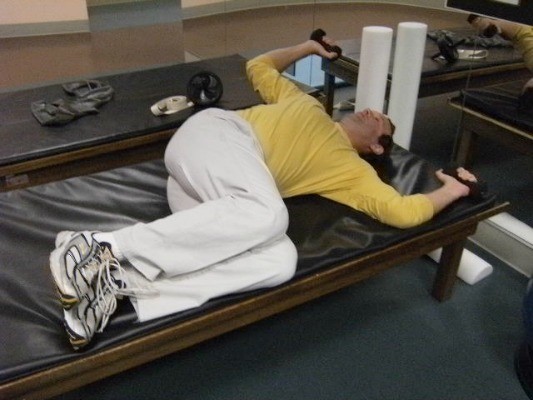
Open Book – Lie on your side in the fetal position with elbows, shoulders, and knees bent at 90 degrees, and a light weight (no more than 1 to 2 lbs.) in each hand. Without changing any of the angles, slowly rotate the top arm up and over, as in opening a book, until a gentle stretch is felt. Keep the knees together. If needed, hold the knees down with the stationary hand. The head will roll until you’re looking at the ceiling. Hold for 10 to 15-seconds and return to the starting position. Make sure to breathe throughout. Do 3 sets, roll over and repeat to the other side.

GOLF FITNESS CLINIC
I’ve developed a highly engaging, 90-minute Golf Fitness Clinic that I present at private clubs and golf organizations throughout the region.
This interactive, value-added member event focuses on the physical demands of the golf swing and helps golfers identify musculoskeletal limitations that may be affecting swing efficiency, performance, consistency, and injury risk. Participants gain a better understanding of how mobility, stability, strength, and balance directly influence their ability to play their best golf.
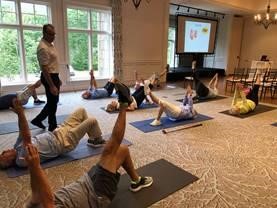
The clinic serves as an excellent complement to the instruction provided by your PGA Professionals by addressing the physical components that support sound swing mechanics and skill development. It can also help increase utilization of an on-site fitness facility or provide a unique wellness offering for clubs without dedicated fitness programming.
Golfers of all ages and skill levels consistently find the program informative, practical, and immediately applicable to their game.
I would welcome the opportunity to discuss bringing this well-received event to your club and members. Please let me know if you would be interested in learning more. You can contact me at bob@golfitcarolina.com.
FUNCTIONAL GOLF FITNESS TRAINING
Expanded Edition
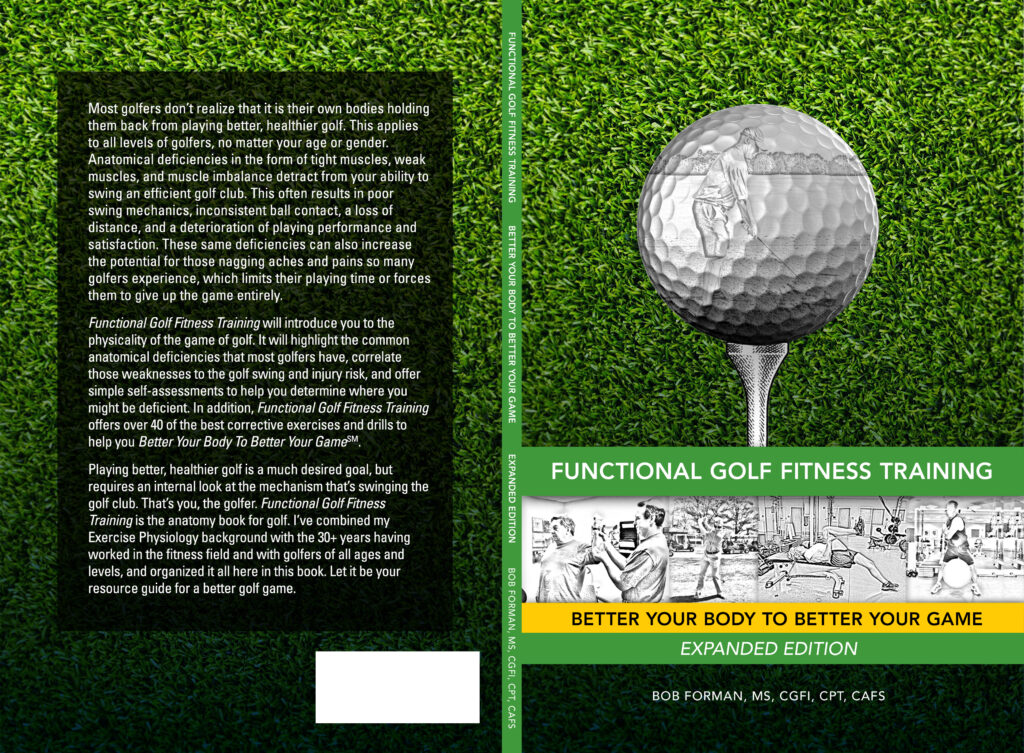
Available at The Book Patch
A great resource for golfers of all ages and levels,
teaching professionals and coaches
PODCASTS
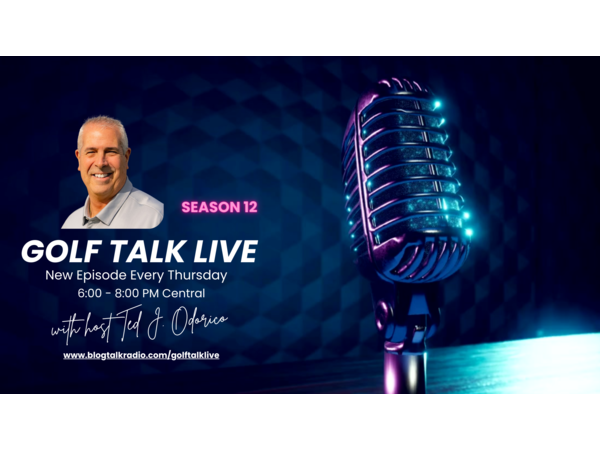
GOLF TALK LIVE
Season 14
Forearm Strength in the Golf Swing – episode 17 – July 9, 2026
https://youtu.be/wenQ-UePOnc?si=cA103X-GFArHj7wI
segment starts around the 40-minute mark
Dynamic Posture in the Golf Swing – episode 16 – June 25, 2026
https://youtu.be/7RGRs7mHKMY?si=AjykE-GqoPr33P32
segment starts at the 44:30 mark
Putting Together an Exercise Program for Golf – episode 14 – June 11, 2026
https://youtu.be/rMbIhK9JL94?si=o8-u1jF4DUyVgKFj
segment starts at the 42:30 mark
Distance – episode 9 – April 23, 2026
https://youtu.be/81rmf1oWQOA?si=pDPd6Xg–VORmhhl
segment starts at the 38-minute mark
Low Back Discomfort, the #1 injury in golf – episode 5 – March 2, 2026
https://youtu.be/IhgShtSBO5Y?si=U1EJHvXh4c0cR7ui
segment starts at the 48-minute mark
GOLF TALK LIVE
Season 13
Golf Fitness for Seniors – episode 31 – November 20, 2025
https://youtu.be/JPoU4KhlaBI?si=is4j2LF6wyipFec5
segment starts right before the 45th minute
Powering Up Your Golf Game – episode 29 – November 6, 2025
https://youtu.be/jREtW07JLrI?si=uJ6OHHRk_gTHedWt
segment starts a the 45th minute
Reverse Spine Angle – episode 27 – October 23, 2025
https://www.youtube.com/watch?v=97zht-_PYSs&list=PL4_5hy0dHybNd2PKZLKKdkj9K5_2RTrJ5&index=1
segment starts right away
Forearm Strength and the Golf Swing – episode 23 – September 11, 2025
https://youtu.be/ipOsA-wzcUc?si=8nAc7T2km7LLVnab
segment begins at the 41-minute mark
Basic Nutrition for Golf and Playing in the Heat – episode 20 – August 14, 2025
https://www.youtube.com/watch?v=girslIZWtPk&list=PL4_5hy0dHybNd2PKZLKKdkj9K5_2RTrJ5&index=1
segment begins at the 43-minute mark
Part II – Fitness Must-Haves for Better Golf – episode 14 – June 19, 2025
https://www.youtube.com/watch?v=A5PykAHsyNk&list=PL4_5hy0dHybNd2PKZLKKdkj9K5_2RTrJ5&index=1
segment begins just after the 41-minute mark)
Fitness Must-Haves for a Better Golf Swing – episode 11 – 5/22/2025
https://www.youtube.com/watch?v=tBPNGFQ9jQQ&list=PL4_5hy0dHybNd2PKZLKKdkj9K5_2RTrJ5&index=1
(segment begins just after the 32-minute mark)
Golf-Specific Exercises – episode 9 – 5/8/2025
https://www.youtube.com/watch?v=jvYBRTPzRbA&list=PL4_5hy0dHybNd2PKZLKKdkj9K5_2RTrJ5&index=3
(segment begins just after the 42-minute mark)
Power Exercises for Golf – episode 6 – 4/10/2025
https://www.youtube.com/watch?v=ufS7-nSOxfs&list=PL4_5hy0dHybNd2PKZLKKdkj9K5_2RTrJ5&index=3
(segment begins at the 48 minute mark)
Strength Training for Golfers – episode 4 – 3/27/2025
https://www.youtube.com/watch?v=odLMzioPcB0
(segment begins at the 43 minute mark)
General Discussion on Fitness for Golf – 10/31/2024
https://www.spreaker.com/episode/gtl-featuring-special-guest-golf-fitness-professional-bob-forman–63077349